
Hello playmates!
The BBC began to develop a set of tactics to maintain their audience.
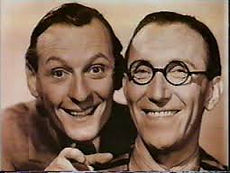 One of these tactics was to broadcast in the same slot each week, a novel idea at the time. Starting on 5th January 1938 and airing every Wednesday for eighteen weeks, Band Waggon was to become a huge success. The show brought together ‘Big-hearted’ Arthur Askey and straight-man Richard ‘Stinker’ Murdoch (right). Together they formed one of radio’s most celebrated double acts. The early episodes were considered by the management to be mediocre, and by the third show the BBC was considering pulling the series.
Askey, no stranger to radio, knew what did and didn’t work on the medium, and suggested he could both improve the current script and add some of his own jokes. The result was a more slick and fast-paced show. He gave it a signature tune and began to interact more with the orchestra and its leader, Jack Hylton.
A fictitious flat on the roof of Broadcasting House where Askey and Murdoch lived was invented. Punchlines leading to an audience groan were sent to “Chestnut Corner”, a clever device for getting away with bad gags. Regular characters were established such as Mrs Bagwash, her daughter Nausea and Billy The Goat. Catchphrases included “Proper ‘um-drum”, “You silly little man” and of course “AYTHANG-YU”. Askey made Band Waggon the first ‘must-listen to’ comedy show for the BBC. The BBC had found the winning formula for comedy radio: lead performers, whacky supporting characters and lots of memorable catchphrases. It was this combination that Ted Kavanagh used when he sat down and wrote the most successful BBC radio show of all time. ITMA - It’s That Man Again began broadcasting in 1939 and was at its height, heard live by over thirty million people world-wide. It ran for over ten years, producing over three hundred shows and helping to sustain morale during WWII.
The three images below are from a recording of ITMA.
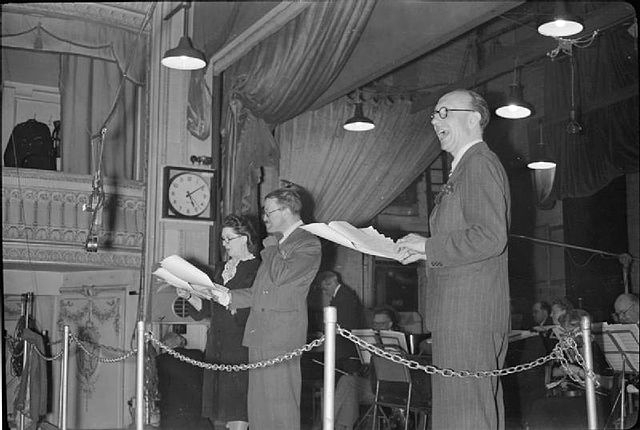
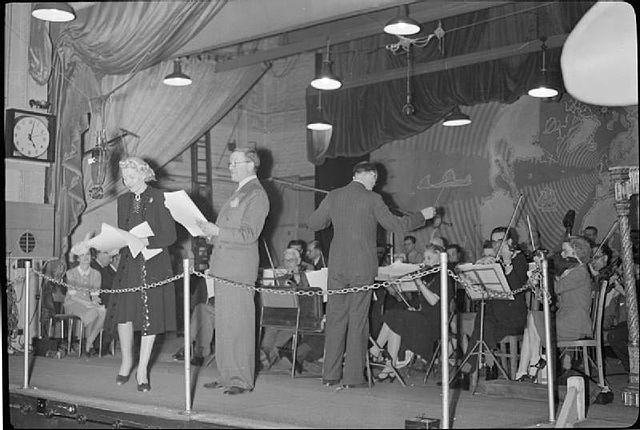
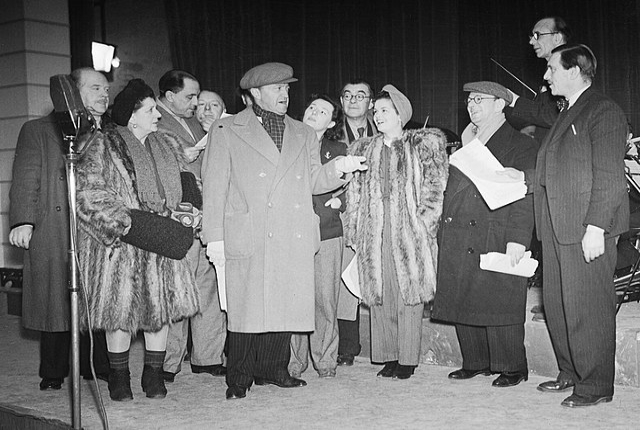
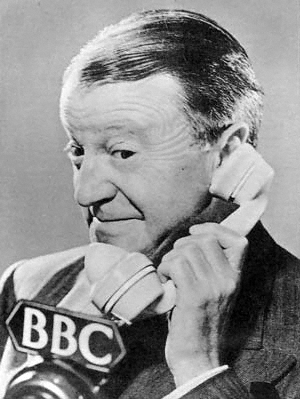 ITMA was hosted by the pun-laden Liverpudlian Tommy Handley (right), who had already been noticed on such radio revue shows as Inaninn, Hot Pot and Tommy’s Tours. Unfortunately, just like the first series of Bandwaggon, ITMA did not go down well with the middle-class audience: they found it generally incoherent, with too many Northern references. But Britain was at war, and the show’s constant jibes about the German army and government made it a favourite among the forces.
The show ran to twelve series, and would no doubt have continued if not for the untimely death of Handley. Three days after recording the 310th episode, he died of a cerebral haemorrhage bought on by high blood pressure. The country was in mourning. Cathedral memorial services for Handley were held simultaneously in Liverpool and St. Paul’s (a first for any performer) and were broadcast live on radio. The Bishop of London, William Wand, said Handley was "one whose genius transmuted the copper of our common experience into the gold of exquisite foolery. His raillery was without cynicism, and his satire without malice”.
The forties became a productive time for the BBC Radio Variety department. Unsettled by war, people tuned in for a morale boost. The department was initially evacuated from London to Bristol where it began to broadcast, but after the fall of France the city was considered unsafe, so Variety was billeted to Bangor in North Wales. It was said the whole department boarded a train at Weston-super-Mare: 204 staff, 514 cases, 175 trunks, 40 bikes, 9 prams, 8 dogs, 8 baby’s cots, 3 cats, 2 hat stands, a parrot and a mangle.
Other successful wartime shows included Garrison Theatre, Hi-Gang! and Ack Ack Beer-Beer, the last of which introduced the listeners to a young Kenneth Horne. ENSA and the gang-shows proved to be a great training ground for many young comedy writers and performers.
Horne himself had been a safety glass salesman before the war, but wrote about military life: his Much-Binding-In-The Marsh was based around the world of the RAF, while Merry-Go-Round was a show catering for each of the three services in weekly rotation. Other radio programmes such as They’re Out and Variety Bandbox were written to entertain the forces overseas but also proved to be popular at home.
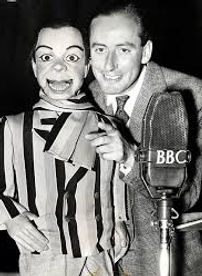 Take It From Here ushered in a golden age for radio comedy, and by the early 50s the BBC was brimming with outstanding shows. These included Fine Goings On with Frankie Howerd, Life With The Lyons, and the star-making vehicle Educating Archie (right). One of Archie’s alumni was Anthony Hancock, who went on to have an enormous hit with the Galton & Simpson series, Hancock’s Half Hour between 1954 and 1959. It was also at this time that a break-through in technology ended the need for a heavy, bulky vacuum tube and gave birth to portable radios with light transistors.
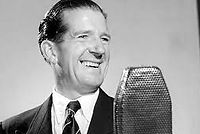 By the end of the decade, radio comedy was being taken seriously. In 1950, the comedians’ weekly visits into family parlours made them household names. Writers and producers were beginning to appreciate the preferences of their working class audiences, creating shows about their lives as seen in Ben Warriss and Jimmy Jewell’s Up The Pole and Ted Ray’s Ray’s A Laugh (left).
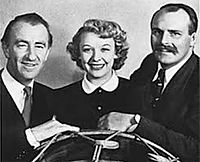 But the portrayal that really hit home was part of a regular sketch on Take It From Here, written by Frank Muir and Dennis Norden. Each week, Jimmy Edward’s overbearing boozy father would lord it over his family The Glums (left), who were suffering the same post-war austerity as their listeners.