
Ying tong ying tong ying tong ying tong...
The world was modernising, and the new listener wanted new comedy. Radio in the fifties was losing its audience to a different medium, television. BBC radio needed something exceptional to keep the public tuned in. Young audiences were keen on the outlandish and bizarre - The Goons was a perfect fit.
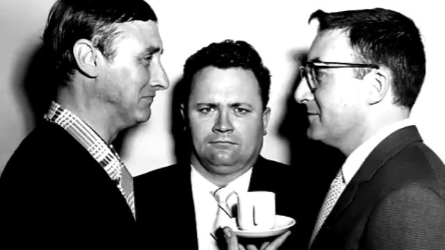
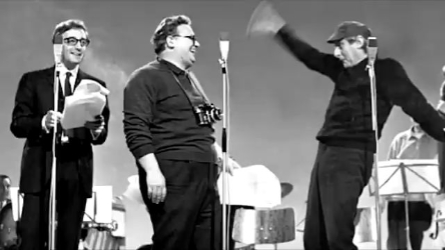
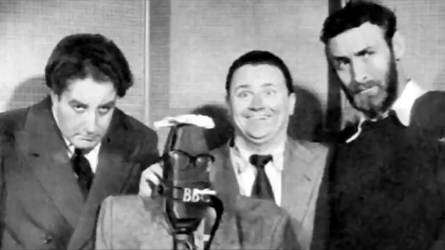
Although never achieving the substantial audiences of ITMA or Take It From Here, The Goons (below) was still the most inventive and influential show ever to be recorded. It made stars of Peter Sellers, Spike Milligan, Harry Secombe and Michael Bentine, who performed ludicrous plots laden with puns, crazy characters and sensational sound effects. Written mostly by the unorthodox Milligan, the show’s surrealism changed not just radio comedy but British comedy.
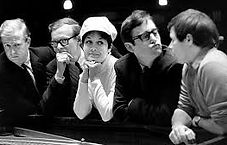 By the beginning of the 1960s, topical shows began to appear. The writing team of David Frost’s That Was The Week That Was moved quickly from television to radio. Two of these writers - Marty Feldman and Barry Took - went on to create Round The Horne; John Cleese and Bill Oddie wrote and performed in Cambridge Circus which was transformed into I’m Sorry, I’ll Read That Again (right) after just three episodes.
Cleese and Oddie also formed part of the so-called Oxbridge set now breaking through in both live and recorded comedy, and which included Tim Brooke-Taylor, Peter Cook, Dudley Moore and Alan Bennett. While their youthful, anarchic style was making an impact, traditional radio sit-coms remained incredibly popular, and none more so than The Men From The Ministry which ran for fifteen years from 1962 and The Navy Lark which ran for eighteen from 1959.
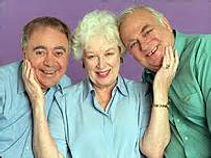 By the mid-70s another wave of news-centric programmes began to make their mark. These included The News Quiz and The News Huddlines (left) created by a young producer, John Lloyd; and Week Ending, a perfect showcase for fledgling writers.
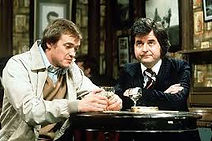 Radio had to start fighting hard against the new family-focused box, and one way was to take a telly favourite and convert it into a radio show, either as a straight lift (Steptoe & Son; The Likely Lads - right), or by placing familiar TV characters in a new plot.
This process occasionally took place in later years: It Sticks Out Half A Mile (1981) was one such programme, in which Dad’s Army characters purchased Frambourne Pier for post-war renovation. Unfortunately, the pilot recordings and most of the series episodes were wiped following a BBC mix-up. Another was Yes Minister (1983) which ran for sixteen episodes on BBC Radio Four.