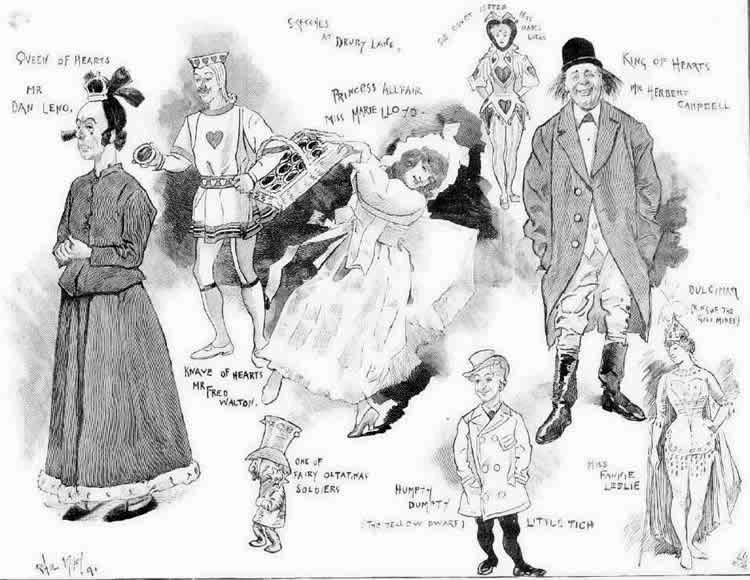
The Christmas Show
Prince Albert’s establishment of the Christmas tree tradition in Britain added to the country’s new focus on the season. Theatres had developed their own seasonal convention in which the pantomime became the Christmas show, but as the original Commedia form segued into a more sweet, childish guise, audiences dropped off and theatres returned to more high-brow scripts. The Comic Almanac noted in 1846 “it is feared that the race of clowns will become extinct in these days of educational enlightenment”.
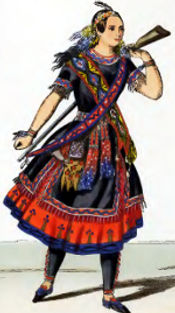 The Adelphi Theatre’s Manager, Benjamin Nottingham Webster (a previous Harlequin at Drury Lane), had a passion for pantomime, and was also an admirer of the new burlesque parodies now in vogue in the West End, in particular the work of actress and contralto Elizabetta Bartolozzi, who had played the male title role in the opera, Don Giovanni. Adapting this twist in gender - a key feature of Burlesque - to his own needs, Webster cast the celebrated dancer, Céline Céleste-Elliott (right) as Jack in the 1855 Christmas production of Jack & the Beanstalk; or Harlequin and Mother Goose at Home Again –‘A grand coalition of Burlesque and Comic Pantomime for young and old’. Madame Celeste was, in all likelihood, the first ever ‘principle boy’.
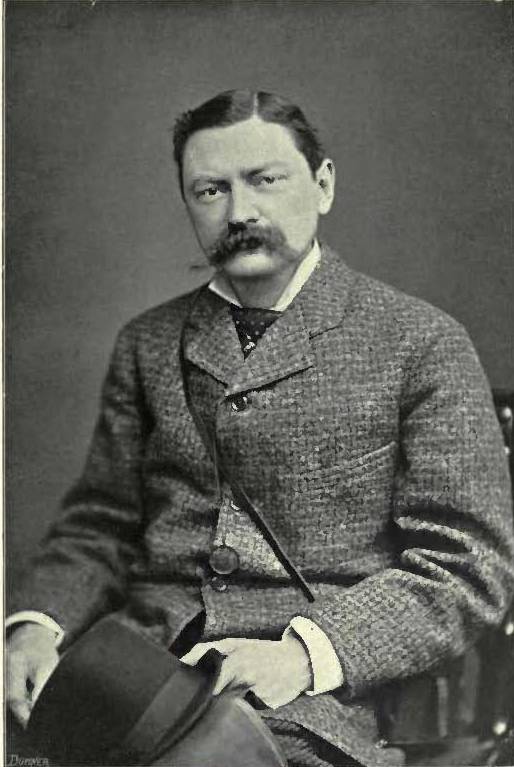 Another important champion of Pantomime at this time was Henry James Byron (left) - a journalist, director, theatre manager, actor, novelist and accomplished playwright. Byron wrote pantomime dialogue in rhyming couplets. His 1860 Cinderella or The Lover, The Lackey and The Little Glass Slipper - ‘A Fairy Burlesque Extravaganza’ gave us the characters Dandini (The Lover) and Buttoni/Buttons (The Lackey). These two roles can be still found in contemporary pantos.
"Love in a ‘Buttons’ may appear a riddle
I know I’m but an ‘umble indiwiddle."
HJ Byron - Cinderella 1860
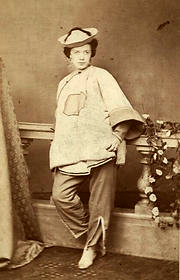 A year later Byron presented Aladdin or The Wonderful Scamp at the Strand Theatre, starring Marie Wilton as Aladdin (right) and James Rogers as The Widow. This matronly character can be traced all the way back to Dell’arte, when the role of La Guaiassa (who gossiped directly with the audience) offered light relief. The Widow character had featured in other theatres’ Pantomimes under various titles including ‘Mustapha’ and ‘Ching Ching’, but Byron wanted something different. He took his inspiration from a tea known to be cheap and past its prime, imported from the Tuon Ky district of China, Twankay. He specified Aladdin’s family as tea pickers in the script, and created a gossiping matriarch, the now famous character of Widow Twankey.
By Christmas 1874, the pantomime had become highly popular again, with even The Great Exhibition at Crystal Palace offering a seasonal show. Drury Lane had Aladdin, Covent Garden Babes in the Wood, Holborn Sinbad, The Pavilion Cinderella, The Princess Beauty & the Beast. Nearly every British theatre and entertainment centre including ice rinks, circuses, Music Halls, supper clubs and concert rooms produced a Christmas pantomime, each one attempting to out-spectacular the other. George Sangers, the new circus showman of London and owner of the Sangers Amphitheatre staged Aladdin and his Forty Thieves with a full menagerie.
Audiences were happy to embrace the fairy tale story so long as its saccharine plot was balanced by the silly patter that was becoming fashionable. This, the pantomime format of the late 1800s, is the one we would recognise in today’s seasonal shows: a convergence of influences culled from fairy tale, Commedia and the Mummers. The structure and sensibility attracted many playwrights of the era, including Frank W. Green, George Conquest, E.L. Blanchard and even the greatest satirical British wit of all time, the king of topsy-turvy himself, W.S. Gilbert, turned their hand to Pantomime.