
Hello Test, one two three four
Before radio, professional comedy for the working-classes was provided by Variety and music halls. This type of entertainment involved sitting in a large, ornate auditorium watching dancers and singers, their elegant performances linked by an assortment of speciality acts ranging from memory men to quick-change artists, from ‘fumbling’ jugglers to fast-talking comics, all leading up to the climax of a top-of-the-bill turn. Perfect Saturday night family entertainment.
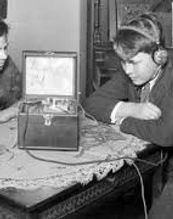 By 1921, a change was in the air. Households were investing in crystal set radios just to listen to Marconi's ‘2MT’ (right). This was a weekly half-hour show in which Peter Eckersley (previously a wartime wireless equipment officer in the Royal Flying Corps) sang, acted, played records and chatted to the listening audience. Radio owners could also tune into American stations and the famous Dutch station, PCGG: all were broadcast from The Hague.
 In May 1922 Marconi’s second station ‘2LO’, and the Anglo-American radio station ‘2ZY’ (later known as the Manchester Metrovic) were granted licences by The Post Office. A surge in the sale of radio sets resulted, and within a month, sixty-three wireless societies had expressed interest in obtaining a licence. Acknowledging the importance of the technology, Britain’s Postmaster General, Frederick Kellaway, decided to establish a sole operator, of which he became General Manager. This move was intended to increase radio’s financial viability and listener choice: on the 18th October 1922, the British Broadcasting Company Limited was formed.
The first transmission would be a month later, on the 14th November. This contained news of the General Election, and one story that was very important to the BBC. Frederick Kellaway had lost his seat and would now have to stand down from his role within the new corporation. 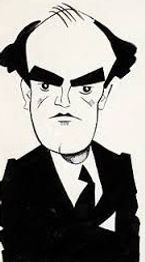 A young engineer with no broadcasting experience, John Reith (left), took over the job. Making up for his initial lack of relevant knowledge, Reith would prove to be the backbone of this fledgling company.
In the twelve years that Reith (later, Lord Reith) was in charge, Light Entertainment (LE) was never at the top of his agenda. Despite imposing the famous BBC directive to “educate, inform and entertain”, Reith admitted to a personal “distaste for Variety shows and dance-band singers”.
The respectability of radio was paramount: one instance of the Reithian way was to ban Sunday broadcasting before 12.30pm, when listeners were assumed to be in church. His dislike for populist entertainment did not, however, prevent some comedy from entering the radio schedules. The first comedian to broadcast officially was Billy Beer who on 16th November 1922 (the second day of broadcasting), gave the nation a monologue entitled “The Parish News”. Twelve days later, the British public heard a show called "The Cat’s Whisker" performed by 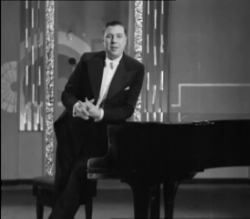 the cheerful chubby comic, Norman Long (right). He wowed the listening audience with his ‘home-made’ songs and was asked back immediately, but with a billing change from “A song, a smile and a piano” to “A song, a joke and a piano”, since the fastidious BBC noted that their listeners could not hear a smile.
In 1927, Long took part in the first-ever transmission of The Royal Command Performance, and in the first nights of The Savoy Hill Studios shows. His first regular radio appearance was as part of Stanelli’s Stag Party, after which he recorded two series of his own: London and Daventry Calling, and Luxembourg Calling. Both were major hits - Norman Long is said to be the first theatre entertainer ‘made’ by radio.