
After The Persecution
The concurrent rise in travelling performers - jugglers, acrobats, storytellers and minstrels - meant that crowds continued to be entertained across Europe at fayres and festive days. Troupes of players would move from town to town, setting up stages or circles to act out storylines based on a glorious Saint, an imaginary wicked, distant kingdom or even a pagan fertility ritual.
Most European states had some form of these travelling companies, but the lack of surviving records plus predominantly illiterate audiences means that little evidence of their work has survived. One extant manuscript from 1150 is The Mystery of Adam, with wonderfully detailed stage directions on how to perform the text outdoors.
In Britain there were many folk players: The Rhymers, The Pace-eggers, The Soulers, The Tipteerers (left), The Wrenboys, The Galoshins, The Guisers and the leading company, The Mummers. The primary season ran between All Fool’s Day (1st April) and All Hallows Eve (31st October), but after a few centuries this was expanded to include Winterfest with its associate carolling traditions of wassailing and yulesinging.
Since Medieval times, an Epiphany Eve (4th January) tradition called for households to bake a ‘King Cake’, the ingredients of which included a dried bean and a dried pea. The cake was cut and placed in the middle of a table so that everyone - masters and servants alike - could take a slice. Whoever found the bean in their slice would be treated as King for the day and whoever had the pea, Queen. If the sex of the finder meant that a man received the pea, or a women the bean, the status of King and Queen held. This was known as the law of misrule, the kingdom of Topsy Turvydom.
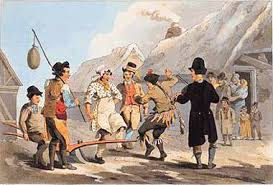 The Topsy Turvydom principle was eventually incorporated into The Mummers’ Plough Play (left) - regularly performed on 5th January (Twelfth Night) - so that female roles could be played by men. Begun as a motivational performance for East Midlands farm labourers on the first Monday of the year, the Plough Play (initially Plough Monday) was a highlight in the 15th century agricultural calendar.
It soon transformed into something we might recognise from a present-day panto: men playing stock characters such as Tom Fool (the young clown) and his mother Dame Jane (a man in a frock) who formed a well-honed double act; and women playing male parts such as Lord Bright-and-Gay or Prince Rich-but-Charming.